
Sustainable branding: turn commitments into useful decisions
Your organisation has made commitments about how it operates. Now the brand needs to help people understand them, choose you for the right reasons and recognise you wherever they meet you.
That creates some useful questions. Which commitments belong in your proposition? What should influence your visual identity? How should the brand work in a tender response, a product launch or a website? And what will your team need to keep using it well?
Sustainable branding connects those decisions. We see it as a practical discipline: build a truthful brand around a useful offer, then consider the resources required to express and maintain it.
Start with what your organisation can stand behind
Bring your business strategy and sustainability evidence into the same conversation. A future ambition, a measured improvement and a product feature each have a different role in the story. Give them clear labels before exploring creative routes.
Your sustainability lead might hold detailed operational evidence while your marketing team understands the customer’s immediate concerns. Both perspectives matter. A technical achievement becomes more useful when you can explain its relevance to the people choosing your service.
For an organisation developing environmental solutions, that relevance could be confidence in its expertise, easier collaboration or a clearer understanding of a complex offer. The environmental mission provides direction; the brand still needs to explain what you do and why someone should work with you.
Turn commitments into design decisions
We recommend a short evidence-to-decision worksheet. Complete one row for each commitment you want the brand to express. The prompts below work in an ordinary document; you can use them in your next planning meeting.
- Commitment: What has the organisation actually decided or done? Separate a current practice from a future target.
- Evidence: Which approved source supports it, what does that source cover, and who can explain its limitations?
- Audience relevance: What does this help a buyer, partner or service user understand or decide?
- Brand decision: Should it shape positioning, language, imagery, the identity system or the way an experience works?
- Application: Where will that decision be tested first: a service page, proposal, product label, event or campaign?
- Ownership: Who will keep the evidence and application current as the organisation changes?
Consider an illustrative business that repairs equipment. Its strongest evidence may be the repair process and service it can deliver. A useful brand decision could be to make that process easy to understand, show the people doing the work and make repair enquiries straightforward. A leaf-shaped logo would add little on its own.
That example also shows why sustainability should influence the customer experience. If repair is central to your proposition, people need a usable route into the service.
Build an identity people can use
Distinctive design helps people recognise your organisation. A workable system helps your team maintain that recognition as the business grows.
Test the identity against real applications early. Can a colleague create a clear presentation? Does a partner know which logo version to use? Can an image be replaced without redesigning the whole page? Are type, contrast and layout choices helping people read the information?
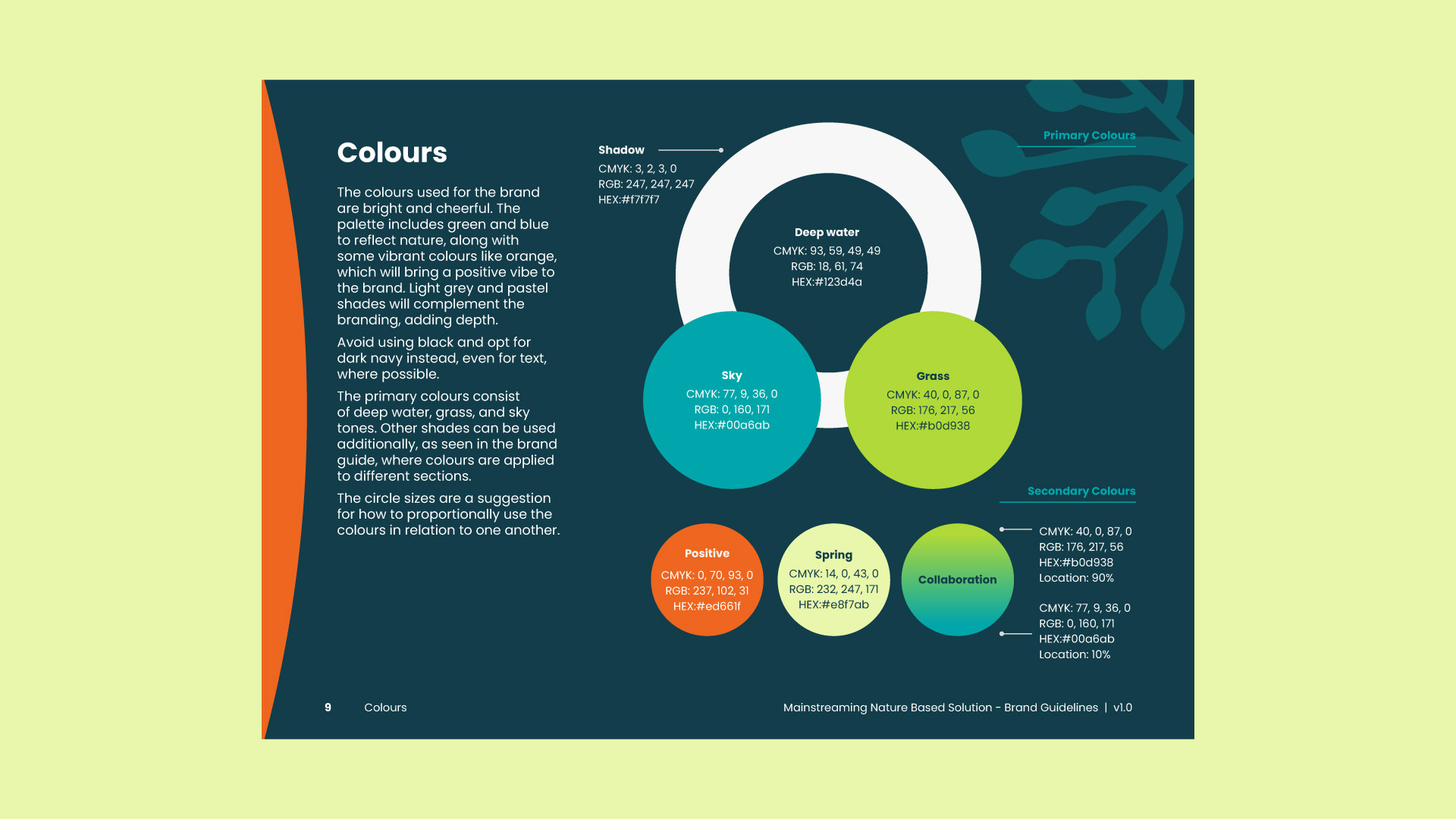
Our work for the Rivers Trust’s Mainstreaming Nature-based Solutions programme brought brand identity, guidelines and a website together for a 23-partner programme. That combination matters: the identity needed a useful life across a complex partnership, supported by guidance and a shared digital presence.
Make production choices around actual use
Ask how each asset will be produced, distributed, updated and eventually replaced. A reusable template may be more useful than a large set of fixed files. A carefully chosen print run may serve a specific audience well. A web page may be easier to maintain when information changes regularly.
Avoid assuming one medium is always the responsible choice. Look at the audience, the quantity required, the expected lifespan and the available production evidence. Record the decision so a future colleague understands why it was made.
The same discipline applies to environmental language. The CMA’s Green Claims Code asks businesses to make clear, evidence-supported claims. For the brand team, the practical task is to keep the meaning and limits of a commitment visible wherever it appears.
Give the brand a clear next decision
Before commissioning more assets, choose one application where your current brand is getting in the way. Bring the audience question, the relevant evidence and the existing materials together. You will have a much clearer starting point for deciding what needs to change.
Our brand work connects strategic direction with identity and practical tools. If your commitments have moved forward and your brand needs to catch up, we can help you define the right response.
