
How to plan a behaviour change campaign with a measurable objective
“Raise awareness” is often the first ambition in a campaign brief. It gives the team a subject to communicate, while leaving an important question open: what do we need people to do as a result?
For a behaviour change campaign, that action deserves careful definition. You need to understand who can take it, the circumstances in which it happens and the barriers that may prevent it. Those decisions give the creative work a clear job and make evaluation more useful.
Write the action in everyday language
Describe something a person can actually do. “Help residents recycle correctly” could become “Place empty drinks cans in the recycling bin provided at the venue.” The second version identifies an action you can investigate, support and observe.
Then specify who performs it, where and when. Avoid treating a broad group as though everyone has the same knowledge, access or motivation. The person you need to reach may be a resident, a member of staff or someone responsible for making the service available.
Agree the relationship between the action and the wider organisational objective. You should be able to explain why encouraging it matters, while being honest about other factors affecting the overall outcome.
Set a review period and an intended level of change once you understand the starting point and available resources. Record the basis for that ambition. This gives your team a realistic objective to work towards and a clear point at which to assess progress.
Investigate what makes the action difficult
Speak with people close to the experience and review existing evidence. Ask what they understand, what happens at the point of action and what makes the desired behaviour easy or difficult. Observation and service-team knowledge can reveal questions a general awareness survey misses.
Government communications guidance uses the COM-B framework to explore capability, opportunity and motivation. In practical terms: can people do it, do their circumstances allow it, and what influences their willingness or habits? These questions can help you organise the evidence and identify where communications can contribute.
Sometimes the service needs to change alongside the message. A clearly labelled recycling point cannot help someone who has no suitable bin within reach. Identify the organisation or partner who can resolve that barrier and make their contribution part of the plan.
Choose the creative response from the evidence
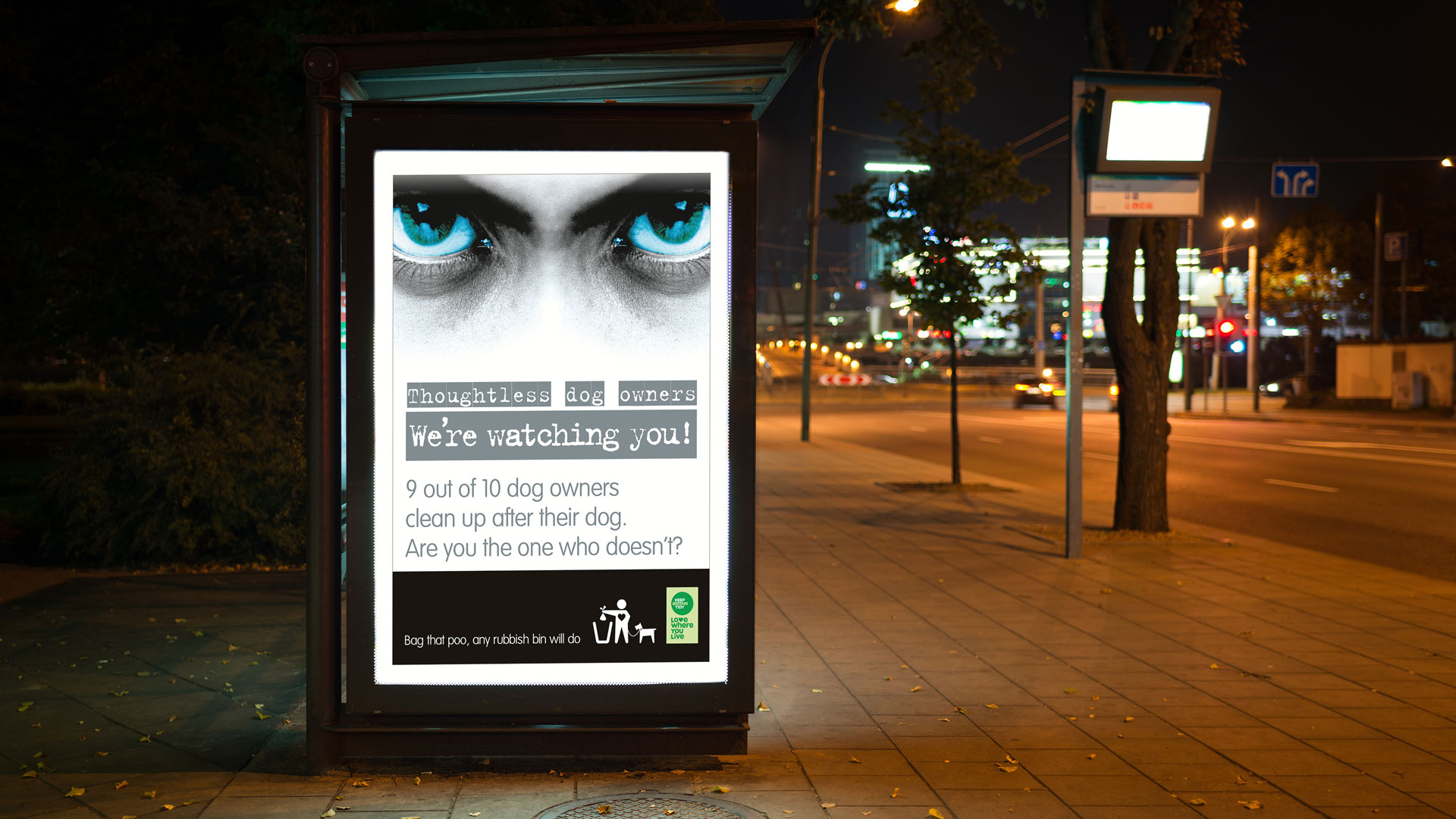
Our Keep Britain Tidy “We’re Watching You” work drew on the client’s research into dog fouling after dark. The creative used eyes and direct messaging, supported by a material that remained visible in dark conditions. The insight influenced both the idea and how it appeared in the environment.
That example is useful because the intervention addressed a specific situation. Read the Keep Britain Tidy campaign case study to see how research and practical constraints shaped the work. A new campaign needs its own audience evidence and testing.
Build a one-page behaviour and measurement brief
Use these seven fields before commissioning campaign concepts:
- Desired action: describe what the priority audience should do, in a particular setting and at an appropriate time.
- Audience and context: record who can act, who influences them and the practical circumstances they face.
- Evidence: summarise what you know about barriers and motivations, naming the source and marking assumptions that need checking.
- Proposed contribution: explain how communication, service changes or environmental prompts could make the action more likely.
- Measures: identify the behaviour you can observe, the supporting indicators and the baseline you need before launch.
- Delivery responsibilities: name who owns creative, permissions, installation, channels, service readiness and data collection.
- Decision after review: agree what evidence would lead you to continue, adapt, investigate further or stop the activity.
Discuss the completed brief with people responsible for delivery. They can identify operational dependencies while there is still time to resolve them.
Work through an illustrative example
Imagine a leisure centre wants visitors to return reusable drinks cups to a collection point. This is an illustrative planning example, not a Carbon project or a reported result.
The team first observes where people finish their drinks and asks what they think should happen to the cup. They find that some visitors leave through a different exit from the collection point. That gives operations a question about placement and gives the creative team a clear information task.
The proposed plan puts the return point on the relevant route and tests a message that explains the action. Before launch, staff agree how they will count cups issued and returned during comparable sessions. They record changes in attendance, collection arrangements and other conditions that could affect the findings.
The plan can now test a useful proposition. The team can assess the practical arrangement and the message together, then investigate what contributed to any difference. Social impressions may describe distribution, but the return behaviour remains the central outcome.
Plan a review you can learn from
Collect a baseline before the campaign changes the setting. Agree the observation method, responsibilities and review points. Where a comparison is feasible, plan it early and involve the appropriate evaluation expertise.
Also consider who may find the requested action difficult and whether the intervention could exclude, confuse or place pressure on people. Testing the message with the intended audience gives you a chance to spot problems before wider delivery.
Our campaign strategy and creative work connects audience understanding with ideas that have a clear purpose. Bring us the behaviour you want to support, the evidence you hold and the conditions your campaign needs to work within. We can help you define the creative challenge and a useful way to assess it.